Professional Artefact = *Aaarrgghhh*
I have spoken to Paula about doing a piece of choreography for my artefact, as I find communicating through dance easier than communicating with words. However, after reading the module handbook I'm concerned that choreography will not portray the complex ideas asked for in the handbook.
What is everyone else doing for their artefacts?
Also I have tried replying to everyone's comments but they just don't seem to be appearing so Lucy and Holly my skype address is no1-dancer if you ever want to chat.
And Katrina thanks for the advice, I too am just writing in the best way I can and then can hopefully adjust it with feedback.
Thanks
Thursday, 1 December 2016

Wednesday, 30 November 2016
Personal Writing
I have struggled for a long time trying to write my professional inquiry, I have tried several drafts of the introduction and evaluation so far, to very little success. I don't have much experience with degree style writing, as a I did a professional diploma instead, and I find it difficult to get into that mind set.
However, I think I try to make my writing too formal, i think this is because I perceive degree writing as a formal endeavour, educational and factual, when in actual fact our inquiries and personal and life based.
So how do I make something personal sound professional? I feel when I write in a personal way my inquiry sounds too journalistic.
Any thoughts fellow BAPPs?
I have struggled for a long time trying to write my professional inquiry, I have tried several drafts of the introduction and evaluation so far, to very little success. I don't have much experience with degree style writing, as a I did a professional diploma instead, and I find it difficult to get into that mind set.
However, I think I try to make my writing too formal, i think this is because I perceive degree writing as a formal endeavour, educational and factual, when in actual fact our inquiries and personal and life based.
So how do I make something personal sound professional? I feel when I write in a personal way my inquiry sounds too journalistic.
Any thoughts fellow BAPPs?
Tuesday, 27 September 2016
Task 7A
Professional InquiryWhere to start?
That is actually my question! I have found it increasingly difficult to know where and how to start this inquiry. Finding a linear approach to my jumbled ideas is challenging, in particular when it comes to starting the written part of the inquiry.
I am also worried that my literature review will be lacking as I am finding it difficult to find relevant articles, papers and books that will help me with my inquiry, has anyone else struggled with this?
I am hoping my interviews will give me lots of information to work with!
I would very much like to join a SIG to do with dance in education if anyone knows of one?
Thanks
Thursday, 21 April 2016
Task 6C
I have chosen the title Musical Theatre mainly because my original qualification from SLP College was in Professional Musical Theatre, but also because this is where I would like my future career to go. My knowledge and expertise is in this area but also my passion.
I would like in the future to have a career as a musical theatre tutor, passing on my passion to other students and continuing to work within musicals and performing. I would like to teach post 16 so I can work with students who are hoping for a career in musical theatre so I can work eith them and share my experiences.
Finally I think this is the most helpful title to achieve this career and is the most relevant to my training and knowledge.
I have chosen the title Musical Theatre mainly because my original qualification from SLP College was in Professional Musical Theatre, but also because this is where I would like my future career to go. My knowledge and expertise is in this area but also my passion.
I would like in the future to have a career as a musical theatre tutor, passing on my passion to other students and continuing to work within musicals and performing. I would like to teach post 16 so I can work with students who are hoping for a career in musical theatre so I can work eith them and share my experiences.
Finally I think this is the most helpful title to achieve this career and is the most relevant to my training and knowledge.
Task 6A
I chose to look int the tool of surveys, for my inquiry in particular I believe this could be useful in establishing how many teachers have experience working with sensory impaired students, this will give an indication as to how many opportunities there are for sensory impaired dance students. It will also help me to find out how teachers adapted their lessons to include these students if they do have experience in this field.
Later on in my inquiry I also intend to carry out lesson observations as this will give me key information and insight as to how teachers prepare and carry out dance lessons including sensory impaired students.
Here is a link to my survey, I chose to use survey monkey as I have used their website before and was pleased with how it worked.
https://www.surveymonkey.co.uk/r/2G5LDLG
Please help me by taking my survey whether you are a dance teacher or a normal teacher!
Thanks.
I chose to look int the tool of surveys, for my inquiry in particular I believe this could be useful in establishing how many teachers have experience working with sensory impaired students, this will give an indication as to how many opportunities there are for sensory impaired dance students. It will also help me to find out how teachers adapted their lessons to include these students if they do have experience in this field.
Later on in my inquiry I also intend to carry out lesson observations as this will give me key information and insight as to how teachers prepare and carry out dance lessons including sensory impaired students.
Here is a link to my survey, I chose to use survey monkey as I have used their website before and was pleased with how it worked.
https://www.surveymonkey.co.uk/r/2G5LDLG
Please help me by taking my survey whether you are a dance teacher or a normal teacher!
Thanks.
Wednesday, 20 April 2016
TASK 5B
I found some documents of code of ethics and practice within teaching, specifically post 16 and SEND
http://dera.ioe.ac.uk/6466/1/code_of_practice__revised__for_providers_of_post-16_education_and_related_services__dda_.pdf
https://www.gov.uk/government/uploads/system/uploads/attachment_data/file/398815/SEND_Code_of_Practice_January_2015.pdf
Even within the Post 16 PDF there is emphasis on SEND students:
"There are various actions which education providers can take in order to avoid discriminating against disabled people. By doing so, education providers are not only likely to improve the overall performance of the institution but will also minimise the incidence of expensive and timeconsuming litigation. In addition, these actions will assist education providers in complying with the Disability Equality Duty, which all those operating in the public education sector will be covered by either directly or indirectly. The Disability Equality Duty requires all public authorities – including education providers covered by the Part 4 duties outlined in this Code – when carrying out their functions to have due regard to the need to: ■ promote equality of opportunity between disabled persons and other persons ■ eliminate discrimination that is unlawful under the Act ■ eliminate harassment of disabled persons that is related to their disabilities ■ promote positive attitudes towards disabled persons ■ encourage participation by disabled persons in public life; and SI 2005/2966 13 2 How can discrimination be avoided? ■ take steps to take account of disabled persons’ disabilities, even where that involves treating disabled persons more favourably than other persons."
Finding information on a specific code of practice for teachers is harder than I thought, there doesn't seem to be a standardised set of rules, just common sense and good training.
I found some documents of code of ethics and practice within teaching, specifically post 16 and SEND
http://dera.ioe.ac.uk/6466/1/code_of_practice__revised__for_providers_of_post-16_education_and_related_services__dda_.pdf
https://www.gov.uk/government/uploads/system/uploads/attachment_data/file/398815/SEND_Code_of_Practice_January_2015.pdf
Even within the Post 16 PDF there is emphasis on SEND students:
"There are various actions which education providers can take in order to avoid discriminating against disabled people. By doing so, education providers are not only likely to improve the overall performance of the institution but will also minimise the incidence of expensive and timeconsuming litigation. In addition, these actions will assist education providers in complying with the Disability Equality Duty, which all those operating in the public education sector will be covered by either directly or indirectly. The Disability Equality Duty requires all public authorities – including education providers covered by the Part 4 duties outlined in this Code – when carrying out their functions to have due regard to the need to: ■ promote equality of opportunity between disabled persons and other persons ■ eliminate discrimination that is unlawful under the Act ■ eliminate harassment of disabled persons that is related to their disabilities ■ promote positive attitudes towards disabled persons ■ encourage participation by disabled persons in public life; and SI 2005/2966 13 2 How can discrimination be avoided? ■ take steps to take account of disabled persons’ disabilities, even where that involves treating disabled persons more favourably than other persons."
Finding information on a specific code of practice for teachers is harder than I thought, there doesn't seem to be a standardised set of rules, just common sense and good training.
Monday, 18 April 2016
I found some interesting questions online about dancers with disabilities
- What are the economic realities for a disabled dance practitioner?
- Is the disabled dancing body more exposed to public consumption than the non-disabled body?
- How do we value dance made by and performed by disabled dancers?
- Can dance made by disabled artists find its rightful place in our cultural heritage?
"Dancers with disabilities encounter unique challenges. The professional dance community broadly supports the removal of labels such as ‘inclusive performance’. Such labels mark disabled dance artists out as ‘other’. Yet, disabled dance artists and performers like Claire Cunningham, Caroline Bowditch and David Toole are slowly making their mark upon the mainstream dance world. There is, however, a long way to go before disabled dances artists are fully integrated. The InVisible Difference project recognises this."
My mum works as a Teacher of the Deaf and I believe this could be a good choice as she can give an inside input on this topic.
I found a list online of dance companies that use disabled:
I also found a paper on "Barriers to dance training for
young people with disabilities" by Imogen J. Aujla 1 & Emma Redding.
I'm definitely going to give this a full read and find some questions within it.
Literature Research
https://www.tes.com/article.aspx?storyCode=6167026
http://www.bbc.co.uk/schools/parents/teaching_assistant/
http://www.skill.org.uk/page.aspx?c=359&p=485
There was an overwhelming answer to my question in these articles...
There are no formal qualifications required to become a Teaching Assistant, however it changes from school to school, from application to application as to what they chose for the necessary requirements.
This isn't particularly helpful when trying to find out how qualified you need to be for the job!
It seems I will need to contact various professionals and schools to find out what they consider to be the perfect teaching assistant.
https://www.tes.com/article.aspx?storyCode=6167026
http://www.bbc.co.uk/schools/parents/teaching_assistant/
http://www.skill.org.uk/page.aspx?c=359&p=485
There was an overwhelming answer to my question in these articles...
There are no formal qualifications required to become a Teaching Assistant, however it changes from school to school, from application to application as to what they chose for the necessary requirements.
This isn't particularly helpful when trying to find out how qualified you need to be for the job!
It seems I will need to contact various professionals and schools to find out what they consider to be the perfect teaching assistant.
Task 5A
As a Dance Teacher there are many guidelines and regulations and ethical questions.
Particularly when working with younger children there are ethical considerations
Patience
Professionalism
Organisation
Passionate
Knowledgeable
Experience
Dedication
I found a good page online at http://ausdance.org.au/articles/details/code-of-ethics-for-dance-teachers
"Code of ethics
As a Dance Teacher there are many guidelines and regulations and ethical questions.
Particularly when working with younger children there are ethical considerations
Patience
Professionalism
Organisation
Passionate
Knowledgeable
Experience
Dedication
I found a good page online at http://ausdance.org.au/articles/details/code-of-ethics-for-dance-teachers
"Code of ethics
- Studio principals will have clearly defined aims and goals. The benefits an individual student can expect to receive through staff's conscientious implementation of these aims and gaols will be clearly stated.
- Studio principals will make sure that the school and its staff is capable of providing any services claimed.
- Studio principals will employ teaching staff with the experience, knowledge and/or qualifications required for the range of levels and techniques being taught. Student teachers will be trained and supervised to ensure the school’s teaching standards are maintained.
- Studio principals will provide effective assessment procedures and will ensure that students and parents receive, or have access to, advice when necessary.
- Studio principals will conform to sound business practice and provide an efficient fee system.
- Studio principals and individual teachers will ensure that class sizes are suitable to the levels and techniques being taught. Students in each class will be of a similar age and/or standard.
- Studio principals and individual teachers will ensure that facilities provided:
- conform with minimum safety and space requirements
- have suitable flooring, with a safe surface designed and constructed to minimise risk of injury.
- Individual teachers will use effective and flexible teaching skills to create a productive learning environment. Individual teachers will:
- strive to communicate a love of dance
- show professional attitudes, including punctuality, reliability and responsible care of students
- strive to develop self-discipline and self-motivation in the students
- encourage and support the individual in the class situation
- present general concepts of movement as well as those of a particular dance style.
- Individual teachers will recognise the role of dance in the development of the whole person. They will also seek to recognise and develop each student’s potential, whether it lies in dance or in related fields, and offer appropriate guidance for further progress.
- Individual teachers will endeavour to recognise physical anomalies, modifying their teaching and seeking medical advice when necessary. The teaching and choreography must be anatomically safe, and teachers must be prepared to deal with medical emergencies.
- Individual teachers will strive to develop in the students an appreciation of the characteristic style of each specific technique taught.
- Individual teachers will take responsibility for seeking more knowledge in all aspects of their work."
How you correct children through physical means is a big ethical conundrum
Do you touch a child?
How do you touch a child if you chose to?
When is it appropriate?
How do you make the child feel comfortable?
These are questions I would like to think about.
Thursday, 31 March 2016
I have been considering different roots related to dance that I could consider for my Inquiry.
I drew a spider diagram, listing some of the things I could look into:

The two I outlined in pink are the two categories I am most interested in.
My Mum is a teacher of the deaf so I would be very interested in looking into how dance and theatre can be used to aid the learning of children who are deaf or blind.
I am currently training to be a TA, so I would also like to look into how qualified you really need to be to become a TA.
I would love some input if anyone has any!
I drew a spider diagram, listing some of the things I could look into:

The two I outlined in pink are the two categories I am most interested in.
My Mum is a teacher of the deaf so I would be very interested in looking into how dance and theatre can be used to aid the learning of children who are deaf or blind.
I am currently training to be a TA, so I would also like to look into how qualified you really need to be to become a TA.
I would love some input if anyone has any!
Thursday, 24 March 2016
In the second section of Reader 4, I was very interested in
the difference between competence and capability, I had considered pointing my
lines of inquiry towards teaching assistants and asking how qualified do they
need to be and what do they really need to know? So this concept has interested
me as there is a marked difference between competence and capability.
“The real issue at the heart of the generic competencies
debate is whether competency attainment is necessary to be a good practitioner.”
Reader 4, Middlesex
University
“Competence, the ability to do a specific job, is one with
which many people are familiar, but capability, the scope to which a person can
gain new knowledge, is perhaps the overriding concept used in WBL in higher
education. Both are important to identify and both can be seen as framing
devices for knowledge in the workplace.” Reader 4, Middlesex University
I’m interested in the idea that purely being competent is
not enough but proving you are capable is another step entirely, I have
recently considered that teaching assistant jobs are becoming increasingly
professionalised, more qualifications are required, despite the actual teaching
experience gained. I have found this myself when applying for TA jobs and have
been recently told, despite my years of teaching experience, with all age
groups, in various different environments, mostly performing arts related, that
I need a formal qualification before any school will hire me. This got me to
thinking what exactly it is that a TA needs to know, if my many years of
leading my own classes are not enough to prove I am capable, what certificate
must I have to prove I am competent? I considered that if I were hiring
someone, as a builder lets say, would I prefer to hire the builder with a certificate
that says he has passed a building test or to hire the builder who has shown me
round a street of houses he has built. Is it (implied) knowledge or experience
which is more important?
Any thoughts?
Wilkommen, Beinvunue, Welcome
Starting Module 2
My first blog for module 2 may be a tad overdue, and as I'm sure many of you will understand, life somewhat got in the way, moving house, working a full time job and doing two courses all at once has meant my commitment to all has not been what it should be. So I am a little behind others in my line of inquiry but I am hoping everyone is willing to get on board with me and discuss our idea together.
So Reader 4, after reading other peoples blogs, I was a little apprehensive as man had said they were a little confused after reading this section. I like most needed to re-read the document to really gin everything I wanted to get out of it. Having previously had a Skype conversation with Paula I had an idea of where my inquiry was going to but reader 4 helped me to consolidate that I was going down the right path.
Links to Work Based Learning
Fisrtly I was struck by Peter Senge's idea of 'learning organisations', his original focus was on businesses and how professional inquiry is useful in the professional business world, but I believe his ideas can be applied to, my chosen career path, teaching.
"…organizations where people continually expand their capacity to create the results they truly desire, where new and expansive patterns of thinking are nurtured, where collective aspiration is set free, and where people are continually learning to see the whole together." Peter Senge, The Fifth Discipline: The Art and Practice of The Learning Organization (1990).
Teaching is a very fast paced and ever changing work environment, no two years in teaching are ever the same, some would argue no two days are the same, so Serge's approach could help to navigate through this industry.
"While all people have the capacity to learn, the structures in which they have to function are often not conducive to reflection and engagement. Furthermore, people may lack the tools and guiding ideas to make sense of the situations they face. Organizations that are continually expanding their capacity to create their future require a fundamental shift of mind among their members." Mark Smith, http://infed.org/mobi/peter-senge-and-the-learning-organization (2001)
Smith suggests that for Senge's 'learning organisation' to work, everyone has to be on board and ready to make the changes necessary to work in a new way and to begin with I struggled to bring to mind any organisation that would have 100% readiness to consistently challenge their employees to learn and question how they can improve. Then I considered that all places of work try this method to some extent or another (with varying degrees of success) whether that be through assessments, catch up interviews or even through simple targets but I doubt that many organisations would be willing to change their entire ethos and attitude towards workplace learning. I have heard in the past that Google are pioneering the way forward for new ways of creating productive work and learning environments in their business and thought I'd see if I could find any information on their business model.
Here is what I found:


Starting Module 2
My first blog for module 2 may be a tad overdue, and as I'm sure many of you will understand, life somewhat got in the way, moving house, working a full time job and doing two courses all at once has meant my commitment to all has not been what it should be. So I am a little behind others in my line of inquiry but I am hoping everyone is willing to get on board with me and discuss our idea together.
So Reader 4, after reading other peoples blogs, I was a little apprehensive as man had said they were a little confused after reading this section. I like most needed to re-read the document to really gin everything I wanted to get out of it. Having previously had a Skype conversation with Paula I had an idea of where my inquiry was going to but reader 4 helped me to consolidate that I was going down the right path.
Links to Work Based Learning
Fisrtly I was struck by Peter Senge's idea of 'learning organisations', his original focus was on businesses and how professional inquiry is useful in the professional business world, but I believe his ideas can be applied to, my chosen career path, teaching.
"…organizations where people continually expand their capacity to create the results they truly desire, where new and expansive patterns of thinking are nurtured, where collective aspiration is set free, and where people are continually learning to see the whole together." Peter Senge, The Fifth Discipline: The Art and Practice of The Learning Organization (1990).
Teaching is a very fast paced and ever changing work environment, no two years in teaching are ever the same, some would argue no two days are the same, so Serge's approach could help to navigate through this industry.
"While all people have the capacity to learn, the structures in which they have to function are often not conducive to reflection and engagement. Furthermore, people may lack the tools and guiding ideas to make sense of the situations they face. Organizations that are continually expanding their capacity to create their future require a fundamental shift of mind among their members." Mark Smith, http://infed.org/mobi/peter-senge-and-the-learning-organization (2001)
Smith suggests that for Senge's 'learning organisation' to work, everyone has to be on board and ready to make the changes necessary to work in a new way and to begin with I struggled to bring to mind any organisation that would have 100% readiness to consistently challenge their employees to learn and question how they can improve. Then I considered that all places of work try this method to some extent or another (with varying degrees of success) whether that be through assessments, catch up interviews or even through simple targets but I doubt that many organisations would be willing to change their entire ethos and attitude towards workplace learning. I have heard in the past that Google are pioneering the way forward for new ways of creating productive work and learning environments in their business and thought I'd see if I could find any information on their business model.
Here is what I found:
"It’s really the people that make Google the kind of company it is. We hire people who are smart and determined, and we favor ability over experience. Although Googlers share common goals and visions for the company, we hail from all walks of life and speak dozens of languages, reflecting the global audience that we serve. And when not at work, Googlers pursue interests ranging from cycling to beekeeping, from frisbee to foxtrot.
We strive to maintain the open culture often associated with startups, in which everyone is a hands-on contributor and feels comfortable sharing ideas and opinions. In our weekly all-hands (“TGIF”) meetings—not to mention over email or in the cafe—Googlers ask questions directly to Larry, Sergey and other execs about any number of company issues. Our offices and cafes are designed to encourage interactions between Googlers within and across teams, and to spark conversation about work as well as play." Google Inc. https://www.google.com/about/company/facts/culture/ (2016)
"You can be serious without a suit.
Our founders built Google around the idea that work should be challenging, and the challenge should be fun. We believe that great, creative things are more likely to happen with the right company culture–and that doesn’t just mean lava lamps and rubber balls. There is an emphasis on team achievements and pride in individual accomplishments that contribute to our overall success. We put great stock in our employees–energetic, passionate people from diverse backgrounds with creative approaches to work, play and life. Our atmosphere may be casual, but as new ideas emerge in a café line, at a team meeting or at the gym, they are traded, tested and put into practice with dizzying speed–and they may be the launch pad for a new project destined for worldwide use." Google Inc. https://www.google.com/about/company/philosophy/ (2016)

This is a photograph from inside the Google headquarters in London, It has a 'bringing the outside, inside' theme.
And this is a photo from the Mountain View site in California, there is a bowling alley in the workplace in line with Google's 'casual atmosphere'.
Now, I'm not suggesting we start putting bowling alleys in the staff room but I think there may be something we can apply from Serge's ideas and Google's ethos that could change how we approach learning and adapting in teaching. There is already a lot of planning, strategy and analysis in teaching, but is it done in the right way? Is it conducted in a healthy and constructive way?
These are two questions I could look at as part of my inquiry and I have only reached the first chapter of Reader 4!
I'd love to hear what other BAPP students, especially those also in teaching field, think about the ways in which work based learning and inquiry are used within teaching.
Tuesday, 5 January 2016

Sunday, 13 December 2015
Task 3a: Current Netoworks
Definition of 'Networking'
“A process that
fosters the exchange of information and ideas among individuals or groups that
share a common interest. Networking may fall into one of two categories -
social or business. In the latter category, one of the implicit objectives is
to form professional relationships that may boost one's future business and
employment prospects.” [1] (investopedia)
I currently
use websites such as Facebook, Twitter and Linkedin, but I recognise that my
current networks are fairly limited and that this is something I need to work
on. I have a couple of contacts who I can call on for jobs or tools or general
help, but I have not built up a vast network of contacts or industry friends.
This may be partly to do with moving into teaching where keeping up with the
current fashionable networks is less important and certainly the networks you
need change, but as a choreographer I have definitely dropped the ball. I could
definitely engage more in the choreographing world, find more new connections
and inspiration, even do some free work to get noticed. Many of the people I
trained with and my theatre friends have vast networks of contacts and websites
that keep them in the loop. Having good connections can get you into secret
auditions, score you some free tickets or even drinks with some famous people
in the industry, all of these can help you further your career. I believe that
the further you progress with your career the more important and useful these
networks are, it becomes more important to be in the know and up to date, more
important to know the right people and say the right things. It is interesting
that we can now network via social media, you can tweet your favourite
performer or share your work with an inspiration in your field, this is a while
new method of creating a career network.
But
why is networking important, how does it benefit us? Having a network can
benefit us is many ways from job opportunities to fame to just having someone
to talk who understands our networking can provide us with many opportunities. This
gives many people motives build strong networks. Most will build networks as
way of advancing in their career, the theatre industry can be being in the
right place at the right time, so networking can get to that place at the right
time. Networking can also be of use even if you’re already at the top of your
field, so many celebrities and theatre industry leaders have social media
accounts, this both aids their ability to achieve more fame and success but conversely
is also a way for the less revered to learn from their idols. Networking is
also a two way connection, you may be as useful to your network as your network
is to you, this provides a nice group environment to networking as everyone can
help each other.
My ideal network would
consist of many leading industry professionals, theatre companies and leading
performing arts schools. As a choreographer and teacher I want to be connected
to emerging young talent, the best performing spaces, inspirational performers
and helpful supporters. Many people use social media and online networking to
raise their profile or to raise money such as Kickstarter, this is a great way
to reach a wider network and a wider range of supporters. It is also important
to think of the way you present your online presence, if you are going to
network via Facebook, it is important to remember to remain professional and
not post anything that might lose you a contact or even a job. You no longer
even need an agent as most auditions are now posted on a variety of theatre
websites such as casting call pro and spotlight, networks created for you,
though they are also used by everyone else so it is not a very exclusive
network.
I definitely believe that
networking is both important and useful and that I certainly could get better
at it (and probably need to). As modern technology pushes ever forwards I
struggle to imagine the ways in which we may begin to network in the future.
[1] Investopedia “Networking”
online. Available from: http://www.investopedia.com/terms/n/networking.asp#ixzz3uEaM8fNt
Task 2d: Inquiry
What in your daily practice gets you
really enthusiastic to find out more about? Who do you admire who also works
with what makes you enthusiastic?
As a choreographer,
choreographing is part of my daily practice and that makes me enthusiastic,
being creative and putting what I think or feel into movement. Sometimes I’m
more limited when working with younger children, but that merely presents more
of a brain challenge to convey my message with fewer steps to choose from.
Using movement to share an idea or an opinion or even just to make the audience
feel a certain way is great fun, sometimes hard work but a great achievement
when it works. One of my favourite choreographers is Mia Michaels, every piece
she choreographs has a different message or feeling, she has a distinct style
but that doesn’t get in the way of the story. Her choreography gives a dancer
room to interpret the emotions and messages for themselves, which gives the
piece a greater depth and more realistic.
What gets you angry or makes you sad? Who do you
admire who shares your feelings or has found away to work around the sadness or
anger?
I get angry or sad as a
teacher, when I see students who are being pushed by their parents, either to
be the best or even into classes they don’t want to do. Pushy parents can be
found in many competitive environments from sport to theatre to academia, but “Dance
Mums” are by far some of the worst. There has even been a television show in America
What do you love about what you do? Who
do you admire who also seems to love this or is an example of what you love?
I love teaching, the sense
of achievement and pride when a child finally gets a step they struggle with or
gets a brilliant exam result, it is a very rewarding profession. You get to
engage with young people, to learn about what they like and what sort of people
they are, you even get to have an impact on their growth as a person which is
an important role. You have the opportunity to pass on morals or passions or
quirks and even friendship. And as a dancer who worked all of their lives to
get into the theatre, although I later realised I wanted to teach, there is no
greater job satisfaction than sharing your love for the theatre. I see many
teacher particularly in the theatre world who really strive to get everything
out of their kids whilst keeping their classes fun and inspiring, which is not
easy I can tell you, because of this I wouldn’t say there is anyone who stands
out as someone I admire. I admire anyone who goes into the teaching profession,
it is not easy, there is a lot of responsibility on your shoulders and a hell
of a lot of pressure to achieve great results, it can often be a thankless job,
rife with criticism and yet we teachers continue to push through all that
because when that one child who really struggles finally achieves what they
thought they never could, it is worth it!
What do you feel you don’t understand? Who
do you admire who does seem to understand it or who has found a way of making
not understanding it interesting or beautiful, or has asked the same questions
as you?
I don’t understand people who
don’t see the importance of education. I find more and more nowadays,
especially when teaching in academic schools rather than performing arts
schools, that very few people have a real enthusiasm for learning. I loved
going to school, I loved learning and taking part and it saddens me to see so
many young people throw away such an opportunity. I fear however that it stems
from our view on education as a whole nation, in Japan
teachers are revered and held up with doctors and lawyers, they are respected
and heralded, and this does not happen in the UK Oxford University
How do you decide the appropriate
ethical response in a given situation? To what extent are disciplinary
responses different to that you might expect more generally in society? For
example, what level of physical contact would you deem appropriate (and not)
from another professional that you would find unacceptable more generally? Why?
Deciding on an appropriate
response to a given situation requires experience and a little “reflection-in-action”
it is interesting that we use this method without even thinking about it.
Unfortunately there are no black and whites with ethics so the correct response
is dependent on many different factors such as environment, age, sex an so on.
If someone punches you in the face the correct response is different if the
person in question is a child than if they were an adult. The same for physical
contact in teaching, as a dance teacher it is considered acceptable to move a
child’s arm or foot to aid their learning as it is a physical subject and
sometimes just saying or showing isn’t enough, feeling is the only way to
improve, however, this is far less appropriate in an academic class such as English
or maths, in this case the environment changes the ethical code. As a teacher I
am regularly required to make tough decisions and discipline children, finding
the correct response and most appropriate course of action can be challenging,
it also difficult to keep the balance between friend and teacher. You want to
have the right amount of fun and enjoyment as this is key to learning but
enough discipline that you are still in charge and respected, this is a hard
balance to strike especially with the added complication of ethic responses.
Friday, 11 December 2015
Task 2c: Reflective Theory
When approaching this task,
I was reminded of various experiences at school, when we were told about
different learning styles and techniques. I spent a long time thinking I was a kinaesthetic
learner, and I do still believe that to be true, but through experience I have
learnt that I learn in multiple ways and they often depend on the type of
learning I’m doing. I think reflective practice is closely linked to this, by reflecting
I have noted other ways of learning and decided that the one technique is not
always the best approach.
Firstly I asked myself, what
is reflection?
I would categorise it as a
key tool in understanding your experiences, enabling you to learn from those
experiences. According to Dewey a reflective thought is an “active, persistent,
and careful consideration of any belief or supposed form of knowledge in the
light of the grounds that support it and the further conclusions to which it
tends” [1] (Dewey, 1933). This is an academic way of saying that reflection
allows us to look back at an experience and use this experience to change our
opinions, our learning and our response to future experiences.
However as noted by Donald Schön
(1987) reflection doesn’t always have to be after the event or experience. Reflection
as I have discussed it so far would be considered ‘reflection-on-action’,
reflecting on something after the event has occurred. I agree with Schön that
there is another form of reflection, which he called ‘reflection-in-action’,
which refers to reflection on an experience during the experience, responding
to the event as it is happening. This particular type of reflection is more
commonly used by artists and theatre practitioners in particular. Dancers
regularly ‘reflect-in-action’ when correcting themselves during a move or a rehearsal,
as a teacher I am always giving pointers and notes, for my students to take
these on board and apply them during the lesson requires ‘reflection-in-action.
I consider ‘reflection-on-action’ to be a much more intellectual and analytical
way of reflecting, it requires deeper thought on the experience and how this
can affect your future experiences, ‘reflection-in-action’ could lead to a
quick decision which later on may prove to be the wrong choice.
Graham Gibbs (1988) came up
with the “Reflective Cycle” based on previous uses of the cycle such as Kolb’s
learning cycle (1975) [2]

Gibbs presents 6 stages of
reflection and how we process our experiences.
Description – What happened?
Feelings – What did you
think and feel about it?
Evaluation – What were the
positives and negatives?
Analysis – What do you make
of it?
Conclusion – What could have
been done differently?
Action Plan – What will you
do next time?
It is a cycle because the
action you take will feed back to the beginning starting the cycle again.
This neatly breaks down the
reflective process into 6 separate thought processes, although they may happen differently
for each person, everyone can view the cycle and see how the process
experiences. Each of the processes links to a different tool for reflection,
describing was discussed in keeping a journal, whereas for me feelings links to
making lists. We may not always process for a long time, these 6 six steps can
happen extremely quickly especially when taking into account Schön’s ‘reflection-in-action’
when correcting a dance mistake you immediately describe the faults in the step, feel that it needs changing, evaluate
what was wrong with the technique, analyse
your process, conclude how to
proceed and improve and then create an action
plan on how to do it right next time. All this happens in a matter of
moments, but it is still there in some form or other.
I can relate to this way of processing
experiences and information, it is a useful learning tool and I regularly use
this in my classes. Dance is such a practical subject that reflecting after the
class is not always useful, because you no longer have opportunity to try out
the changes or feel the body learn from the evaluation. It is however useful to
process feelings and struggles with the career and environment of performing,
getting turned down from a string of auditions can be a difficult mental
process and reflection can really put your feelings into perspective and is
very important if you wish to keep up your confidence and drive. It helps you
to persevere by reflecting on how you feel about rejection and what you can do
at the next audition to improve your results but also just to come to terms
with the face the industry is a tough place to work in and that you may not
have done anything wrong and that what you need to learn is to be strong.
Samantha Davies (2005)
discussed the benefits and limitations of reflective practice. [3]
Benefits
to reflective practice include:
·
Increased
learning from an experience or situation
·
Promotion of
deep learning
·
Identification
of personal and professional strengths and areas for improvement
·
Identification
of educational needs
·
Acquisition of
new knowledge and skills
·
Further
understanding of own beliefs, attitudes and values
·
Encouragement of
self-motivation and self-directed learning
·
Could act as a
source of feedback
·
Possible
improvements of personal and clinical confidence
Limitations to reflective practice include:
·
Not all
practitioners may understand the reflective process
·
May feel
uncomfortable challenging and evaluating own practice
·
Could be time
consuming
·
May have
confusion as to which situations/experiences to reflect upon
·
May not be
adequate to resolve clinical problems
I can identify with several
of these benefits and can see the improvement in my students by asking them to
tell me one good thing about their class and one bad thing about their class, I
can see that this simple evaluation not only gives a sense of achievement but helps
them to self-motivate and learn from their experiences. I can also see that
some students find it more difficult than others to come up with evaluation
that quickly which leads me to assume they prefer to use ‘reflection-on-action’
and take time and distance to process their experience.
I believe we all use a
mixture of all these theories depending on what we are experiencing and what
said experience demands from us from a growth perspective. I have however
changed my opinion on reflection, I have never kept a diary before or gone out
of my way to fully set out my reflection and having tested it both on myself
and my students I can really see the benefits of just a small amount thought
out reflection rather than just what we do automatically, I can see it change
their thought processes when dancing in class and I can attest to how it has
helped me change my emotions towards certain difficult experiences.
Bibliography
[1] Dewey, John (1933) How we Think, 2007 reprint, Champaign: Standard Publications, Inc.
[2] Gibbs, Graham (1988) “Reflective
Cycle” online. Image available from: http://www.cumbria.ac.uk/public/liss/documents/skillsatcumbria/reflectivecyclegibbs.pdf
[3] Davies, Samantha (January
2012). "Embracing reflective practice". Education for Primary Care:
9–12
Other reading sources used
but not quoted
Kolb, D. A. (1984)
Experiential Learning, Englewood
NJ
Tuesday, 8 December 2015
Task 2b: My Journal Writing Experience
Apparently keeping a journal can have an effect on your health.....
"Writing seems to help the brain regulate emotion unintentionally. Whether it's writing things down in a diary, writing bad poetry, or making up song lyrics that should never be played on the radio, it seems to help people emotionally," [1] (Dr Lieberman 2009)
There are many ways in which keeping some form of diary can help you;
Simple old fashioned writing in a book about my day:
Really not for me, I found this way of evaluating and describing rather tedious and it didn't provide me with much closure on my day. It is hard to focus on specific moments or events if you are writing about your whole day.
Lists:
This I found much easier, it is a much simpler way of finding out how you felt about the day. I tried listing good things about my day or bad things about my day, listing the people i'd spoken to or the places I'd been. This gave me a much quicker idea of how I felt about my day and what had stood out.

Reflection:
I tried reflection in many different ways, whether it be picking out a specific event of the day and reflecting on how I felt about, what I could have improved or what I did well. I also tested several diagram methods such as using a pie diagram to divide up my emotions for the day.
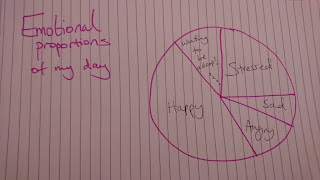
In conclusion the journal writing experience was nowhere near as bad as I expected, i'm not sure that I would keep it up as a daily habit, but it could definitely be useful when working through difficult decisions or tough times. I can also see the benefits on our emotional health that diary keeping can have and how it could be used in a professional environment.
[1] Dr Leiberman 2009, as quoted in "keeping a Diary Makes You Happier" by Ian Sample, online. Available from: http://www.theguardian.com/science/2009/feb/15/psychology-usa
Apparently keeping a journal can have an effect on your health.....
"Writing seems to help the brain regulate emotion unintentionally. Whether it's writing things down in a diary, writing bad poetry, or making up song lyrics that should never be played on the radio, it seems to help people emotionally," [1] (Dr Lieberman 2009)
There are many ways in which keeping some form of diary can help you;
- Clarify your thoughts and feelings
- Know yourself better
- Reduce stress
- Solve problems more effectively
- Resolve disagreements with others
Simple old fashioned writing in a book about my day:
Really not for me, I found this way of evaluating and describing rather tedious and it didn't provide me with much closure on my day. It is hard to focus on specific moments or events if you are writing about your whole day.
Lists:
This I found much easier, it is a much simpler way of finding out how you felt about the day. I tried listing good things about my day or bad things about my day, listing the people i'd spoken to or the places I'd been. This gave me a much quicker idea of how I felt about my day and what had stood out.

Reflection:
I tried reflection in many different ways, whether it be picking out a specific event of the day and reflecting on how I felt about, what I could have improved or what I did well. I also tested several diagram methods such as using a pie diagram to divide up my emotions for the day.

In conclusion the journal writing experience was nowhere near as bad as I expected, i'm not sure that I would keep it up as a daily habit, but it could definitely be useful when working through difficult decisions or tough times. I can also see the benefits on our emotional health that diary keeping can have and how it could be used in a professional environment.
[1] Dr Leiberman 2009, as quoted in "keeping a Diary Makes You Happier" by Ian Sample, online. Available from: http://www.theguardian.com/science/2009/feb/15/psychology-usa
Task 2a: Reflective Writing
I must admit that reflective writing is not my forte. I, as everyone does, process my experiences and thoughts, but i do not generally commit them to paper. This task is somewhat daunting to me, it doesn't feel like a natural process, I would normally listen to some music or process my thoughts and feelings just in my head. I am more than willing to give it a go, who knows it may be a revelation as there are supposed to be many benefits to keeping a Journal.
Having looked at different ways to keep a diary, I have decided on the good old fashioned written approach, audio diaries is a step too far for me, though I may explore the use of mind maps or bullet points as well. I have purhased a new note book expressly for the purpose of keeping my written journal, I'm hoping this will encourage me to do so more regularly!
Here goes nothing........!
Task 1d: 2d Images
In task d we were asked to create a Flickr account and post a set of images to said account.
I have never been big on posting photos to anything other than facebook, and normally if I want to store things I will use google photos, but the website itself was very nice and creating the profile was relatively simple.
https://www.flickr.com/photos/138244248@N06/
The use of audio and visual attachments has become ever present in our communication, particularly on social media. It can sometimes be a more creative and often more encompassing way of putting across your point. There are even websites devoted to posting images or videos such as Flickr, Imgur, Instagram, Vimeo, Youtube and Vine (to name but a few). This is a huge leap forwards in communication as it passes language and race barriers and can be used to put forward an opinion or idea in a more accepted way. Many charities have taken full advantage of this such as the "no make-up selfie" and the water bucket challenge, raising thousands of pounds for charity, though I'm not sure how much awareness as I couldn't tell which charities they were! Facebook is also now full of videos and photos displaying the current news and political opinions, many feminist videos, refugee appeals and anti terrorist explanations, information can be conveyed simply and interestingly through image and video. There are down sides to this form of communication however, once your image or video is out on the internet, who does it now belong to? Many teachers across the world have been highlighting this in their internet safety classes by posting photos and seeing how far they travel through shares and posts on Facebook, I have seen several spanning Australia, America and England. We also gain access to images and videos that we might not want to be privy to, such as the horrific images of the regugee child on the beach, this image was plastered on Facebook and I had scrolled down my feed to see this image before i got the chance to decide if I wanted to see it or not. Is there an easy way to sensor the images we see? I doubt it, especially as I fully believe in free speech.
I have enclosed a link to my Flickr account, photos all uploaded with my consent :)
In task d we were asked to create a Flickr account and post a set of images to said account.
I have never been big on posting photos to anything other than facebook, and normally if I want to store things I will use google photos, but the website itself was very nice and creating the profile was relatively simple.
https://www.flickr.com/photos/138244248@N06/
The use of audio and visual attachments has become ever present in our communication, particularly on social media. It can sometimes be a more creative and often more encompassing way of putting across your point. There are even websites devoted to posting images or videos such as Flickr, Imgur, Instagram, Vimeo, Youtube and Vine (to name but a few). This is a huge leap forwards in communication as it passes language and race barriers and can be used to put forward an opinion or idea in a more accepted way. Many charities have taken full advantage of this such as the "no make-up selfie" and the water bucket challenge, raising thousands of pounds for charity, though I'm not sure how much awareness as I couldn't tell which charities they were! Facebook is also now full of videos and photos displaying the current news and political opinions, many feminist videos, refugee appeals and anti terrorist explanations, information can be conveyed simply and interestingly through image and video. There are down sides to this form of communication however, once your image or video is out on the internet, who does it now belong to? Many teachers across the world have been highlighting this in their internet safety classes by posting photos and seeing how far they travel through shares and posts on Facebook, I have seen several spanning Australia, America and England. We also gain access to images and videos that we might not want to be privy to, such as the horrific images of the regugee child on the beach, this image was plastered on Facebook and I had scrolled down my feed to see this image before i got the chance to decide if I wanted to see it or not. Is there an easy way to sensor the images we see? I doubt it, especially as I fully believe in free speech.
I have enclosed a link to my Flickr account, photos all uploaded with my consent :)
Task 1c: Audio Visual
In task c we were asked to create a Youtube channel and to upload a video entitled "Starting out on BAPP Arts", I decided as I have no disernable drawing skills and no space to video me dancing that I would take head from our previous task on Web 2.0 and join the social media convention of posting a video of writing! It is short and sweet enjoy.
Subscribe to:
Posts (Atom)